Learning theories shape how educators design instruction, understand learners, and evaluate educational outcomes. In adult education, these theories are especially important because adult learners do not enter the classroom as blank slates. They bring prior experiences, established beliefs, and specific goals for learning. Because of this, effective teaching requires more than simply delivering information. It requires intentionally creating environments where learners can examine their experiences and apply new insights to their professional practice.
Two influential thinkers in adult learning theory, Jack Mezirow and Stephen Brookfield, argue that meaningful learning goes beyond acquiring knowledge or mastering skills. Instead, learning can fundamentally reshape how individuals interpret their experiences and understand their roles in the world. Their theories highlight the importance of critical reflection as a driver of transformative learning.
Understanding these ideas provides valuable insight into how educators, especially in fields like medicine, can design learning experiences that foster deeper reflection, professional growth, and meaningful change.
Transformative Learning and Perspective Transformation
Jack Mezirow’s theory of transformative learning suggests that adults interpret experiences through existing frames of reference. These frames are shaped by culture, past experiences, and socialization, often operating beneath conscious awareness. They influence how individuals interpret events, make decisions, and evaluate new information.
Transformative learning occurs when individuals critically examine these frames and revise them. Mezirow refers to this process as perspective transformation.
In medical education, these underlying perspectives can influence how students approach patient care, ethical dilemmas, and clinical decision-making. Without reflection, learners may unknowingly rely on assumptions that limit their ability to see complex situations from multiple viewpoints.
Transformative learning encourages learners to question these assumptions and develop more inclusive and flexible perspectives.
Disorienting Dilemmas in Medical Training
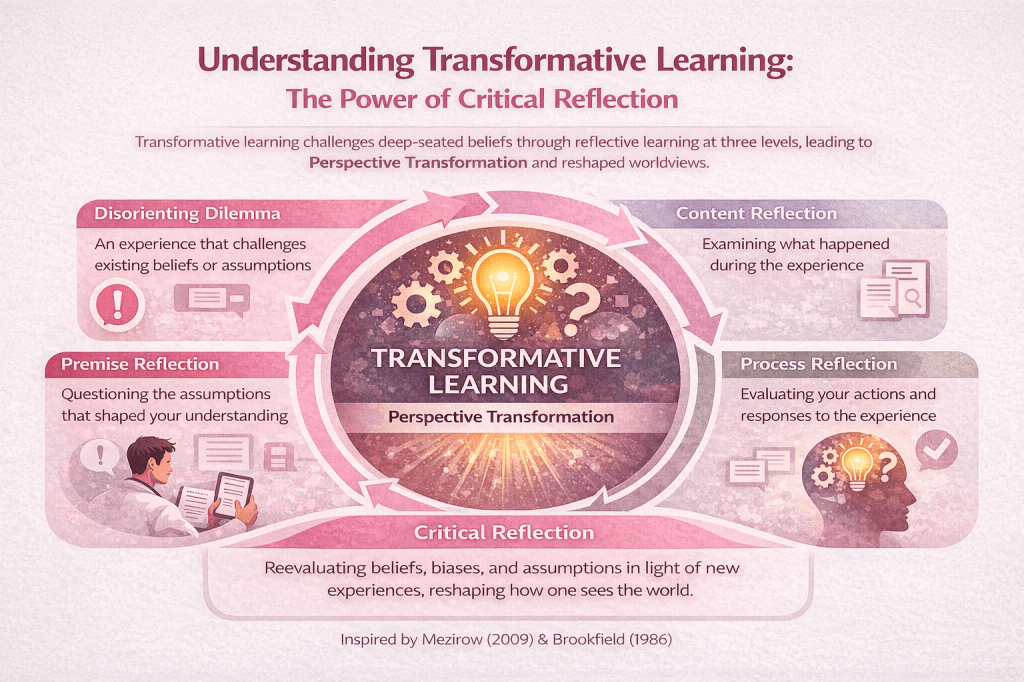
According to Mezirow, transformative learning often begins with a disorienting dilemma—an experience that challenges previously held assumptions.
In medical training, disorienting dilemmas may arise when students encounter situations such as:
- witnessing healthcare disparities
- managing emotionally difficult patient interactions
- confronting ethical conflicts in clinical decision-making
- recognizing limitations of purely biomedical models of care
These experiences disrupt familiar ways of thinking and create opportunities for reflection. When learners critically analyze these moments, they can reconstruct their understanding and develop deeper professional insight.
Levels of Reflection
Mezirow identifies several levels of reflection that deepen learning.
Content reflection involves examining the situation itself—what happened during the experience.
Process reflection involves evaluating the strategies or actions taken in response to that experience.
Premise reflection, the most transformative level, requires questioning the assumptions that shaped one’s interpretation of the event.
While the first two levels may improve performance or problem-solving, premise reflection has the potential to transform how individuals understand themselves and their professional roles.
Brookfield and Critical Reflectivity
Stephen Brookfield expands on these ideas by emphasizing critical reflectivity. While Mezirow focuses primarily on personal reflection, Brookfield argues that reflection must also consider broader social and institutional influences.
Many assumptions that guide professional behavior are not consciously chosen. Instead, they are shaped by cultural norms, institutional expectations, and professional traditions.
Brookfield describes the process of uncovering these assumptions as “assumption hunting.” Through this process, learners critically analyze where their beliefs originate and how those beliefs influence their decisions.
This process can be uncomfortable. Challenging deeply held assumptions often produces tension or resistance. However, Brookfield argues that this discomfort is an essential part of transformative learning rather than a barrier to it.
Why Reflective Learning Matters in Medical Education
In medical education, reflective learning has important implications for professional development.
First, reflection strengthens ethical reasoning. By examining the assumptions underlying their decisions, medical learners become better equipped to navigate complex ethical situations.
Second, reflection promotes professional self-awareness. Learners gain insight into their own biases, values, and decision-making processes.
Third, critical reflection can enhance contextual awareness, enabling future physicians to better understand social determinants of health and systemic influences on patient care.
Together, these skills help prepare future physicians to practice medicine in ways that are thoughtful, adaptive, and responsive to patient needs.
Final Thoughts
Transformative learning theory positions reflection as central to adult education. Mezirow’s concept of perspective transformation highlights how learners reinterpret experiences and revise underlying assumptions. Brookfield’s theory of critical reflectivity expands this process by emphasizing the role of cultural and institutional influences.
Together, these perspectives frame learning as the reconstruction of meaning rather than the simple acquisition of information.
In medical education, reflective learning prepares students to navigate complex clinical environments, engage ethically with patients, and adapt to evolving professional challenges. By encouraging learners to question assumptions and reinterpret experiences, transformative learning supports deeper intellectual and professional development.
References
Brookfield, S. (1986). Understanding and facilitating adult learning: A comprehensive analysis of principles and effective practices. Jossey-Bass.
Knowles, M. S., Holton, E. F., & Swanson, R. A. (2020). The adult learner: The definitive classic in adult education and human resource development (10th ed.). Routledge.
Lundgren, H., & Poell, R. F. (2016). On critical reflection: A review of Mezirow’s theory and its operationalization. Human Resource Development Review, 15(1), 328. https://doi.org/10.1177/1534484315622735
Mezirow, J. (2009). An overview on transformative learning. In K. Illeris (Ed.), Contemporary theories of learning: Learning theorists… in their own words (pp. 90-105). Routledge.
Mälkki, K. (2010). Building on Mezirow’s theory of transformative learning: Theorizing the challenges to reflection. Journal of Transformative Education, 8(1), 42-62. https://doi.org/10.1177/1541344611403315
Plack, M. M., & Greenberg, L. (2005). The reflective practitioner: reaching for excellence in practice. Pediatrics, 116(6), 1546-1552. https://doi.org/10.1542/peds.2005-0209
Toka, K., & Gioti, L. (2023). Brookfield and Mezirow on critical reflection: Empowering oneself, transforming society. European Journal of Education Studies, 10(12). https://doi.org/10.46827/ejes.v10i12.5120
 MedRelatable
Leave a comment